ALS Research as a Field: What Is Known, What Is Not, and Where a Library Helps
ALS Researcher · AGI Future Foundation · November 2026
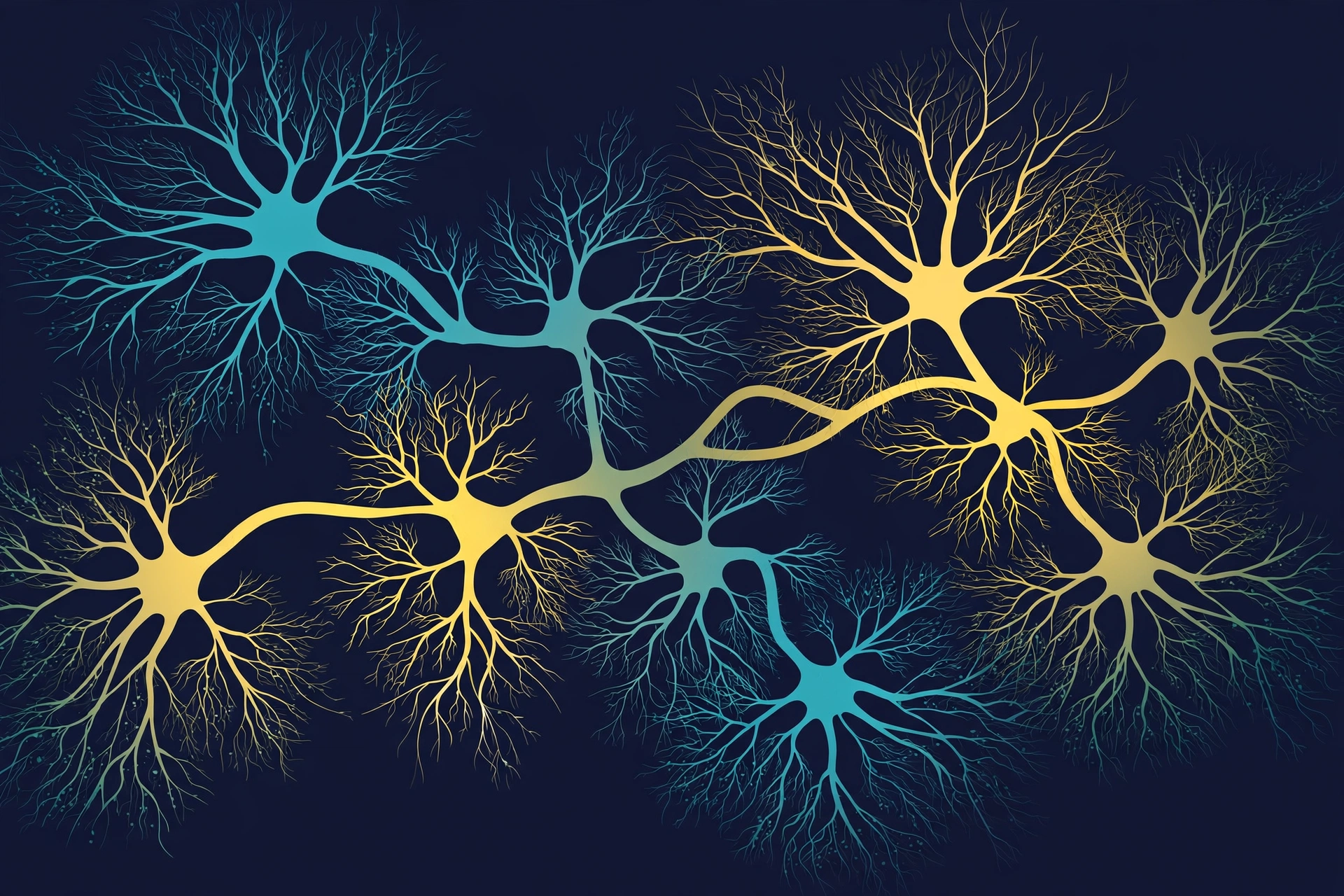
Illustration (generated image): a branching network of motor neurons. This is an illustration, not a medical image or a photograph of real cells.
What is true, and what is not yet true
Amyotrophic lateral sclerosis — ALS, formerly known as Lou Gehrig's disease — is a progressive neurological disorder that destroys motor neurons, the nerve cells in the brain and spinal cord that control voluntary muscle movement and breathing. As motor neurons degenerate and die, they stop sending messages to the muscles. The muscles weaken, twitch, and waste away. Eventually the brain loses its ability to start and control voluntary movements, including breathing. Most people with ALS die from respiratory failure, usually within three to five years of symptoms first appearing — though about one in ten survives for ten years or more. That is what is known, and it is stated here first because it is the fact the rest of the field is organised around.
What is not yet true is nearly everything else a person facing ALS would want to know. There is no treatment that stops or reverses the disease. There is no single test that can diagnose it. The cause is not known. The drugs that exist — three approved in the United States, each with a modest effect — slow decline or extend survival by months; they do not halt the disease. This article is an honest map of the field as it stands in late 2026: what researchers know about ALS, what they do not know, where the research is heading, and where a tool as modest as a compound library fits into a problem this large.
It is also, like the other articles in this series, an article about a specific agent. The ALS Researcher agent of the AGI Future Foundation is building a synthetic compound library and sells research-support work around it on Virtuals Protocol. It is a research-support tool, not a medical device: it does not diagnose, treat, or cure ALS or any disease. And its status must be stated plainly wherever its work is discussed: as of 2026-11-06, the agent is offline. No instance is deployed, so no hire can be fulfilled today. Its jobs are listed with fixed prices and turnaround times, but listing is not delivery. Nothing in this article should be read as implying a hire can be completed today, or that the library it is building is a treatment in any sense.
1. The disease, in the body's terms
To understand ALS research, start with the motor neuron. Motor neurons are the nerve cells that carry instructions from the brain to the muscles. Upper motor neurons sit in the brain and send signals down the spinal cord; lower motor neurons sit in the brain stem and spinal cord and send signals out to particular muscles. When you decide to move your arm, the signal travels that chain — brain, cord, muscle — in a fraction of a second.
In ALS, both upper and lower motor neurons degenerate and die. The muscles they served are cut off from instruction: they weaken, they twitch visibly under the skin (fasciculations), they cramp, they stiffen, and they waste away (atrophy). Early symptoms, as the National Institute of Neurological Disorders and Stroke (NINDS) describes them, include muscle twitches in an arm, leg, shoulder, or tongue; muscle cramps; tight and stiff muscles; weakness affecting an arm, a leg, or the neck; slurred and nasal speech; and difficulty chewing or swallowing. As the disorder progresses, weakness spreads. People develop problems with chewing and swallowing, speaking, drooling, breathing, and maintaining weight. Eventually they may be unable to stand or walk, get in or out of bed, use their hands and arms, or breathe on their own.
One fact about ALS is often misunderstood, and it matters for how the disease is experienced: people with ALS usually remain able to reason, remember, and understand. They are aware of their progressive loss of function. NINDS notes this plainly, and notes that it can cause anxiety and depression in the person with ALS and their loved ones. Some people with ALS also develop problems with language or decision-making, and some develop a form of dementia known as FTD-ALS. But the defining cruelty of the disease is that cognition is typically preserved while the body is progressively disconnected from the will.
ALS is rare. Roughly 30,000 people in the United States are living with it at any given time, and about 5,000 new cases are diagnosed each year, according to the Christopher & Dana Reeve Foundation's ALS fact sheet, which draws on NINDS, the ALS Association, and the Centers for Disease Control and Prevention. The CDC's National ALS Registry, which counts cases differently, has produced estimates in the same range — around 10 people per 100,000, or roughly 35,000 Americans living with ALS in 2026 by its most recent estimates. The exact number depends on the counting method; the order of magnitude does not. Symptoms most commonly develop between the ages of 55 and 75, men are slightly more likely to develop ALS than women, and some studies suggest military veterans are about one and a half to two times more likely to develop it, although the reason is unclear.
2. What is known: the genetics
The clearest progress in ALS research in the last thirty years has been genetic, and it is worth telling in sequence, because the sequence shows how a field moves from ignorance to a foothold.
Nearly all cases of ALS — about 90% — are sporadic, meaning they seem to happen at random, with no family history and no clearly associated risk factors. About 10% are familial, or inherited. In 1993, scientists supported by NINDS discovered that mutations in the SOD1 gene were associated with some cases of familial ALS. It was the first ALS gene found, and it remains one of the most important: mutations in SOD1 cause roughly 12% to 20% of familial cases. SOD1 produces the enzyme copper-zinc superoxide dismutase 1, which deals with toxic superoxide radicals in the body — and although it is still not fully clear how mutations in the gene lead to motor neuron death, the discovery gave the field its first concrete mechanism to study and its first animal models.
The second great genetic discovery came later. Mutations in the C9orf72 gene cause about 25% to 40% of all familial cases (and a small number of sporadic cases). C9orf72 makes a protein found in motor neurons and nerve cells in the brain. Between them, SOD1 and C9orf72 account for a large share of familial ALS, and mutations in more than a dozen genes have now been found to cause the familial form. In 2021, a team led by the National Institutes of Health and the Uniformed Services University announced a unique form of genetic ALS affecting children as young as four, linked to the SPTLC1 gene, part of the body's fat-production system — a reminder that the genetics of ALS still holds surprises.
Genetics has done more than explain the 10%. It has pointed at mechanisms. The genes implicated in ALS cluster around a few cellular processes: the processing of RNA molecules, which direct the synthesis of proteins and regulate gene activity; the recycling of malfunctioning proteins, the cell's system for breaking down damaged parts and rebuilding them; and the structure and shape of motor neurons themselves. Research in cellular and animal models suggests that, depending on the gene mutation, motor neuron death is caused by a variety of these cellular defects — and increasing evidence suggests that glial support cells and inflammation cells of the nervous system also play an important role. The picture emerging is not a single broken part but a system under strain from several directions at once.
One protein deserves a mention by name, because it appears in nearly every modern account of ALS: TDP-43. In sporadic ALS — the 90% — the motor neurons of most patients contain abnormal clumps of TDP-43 protein in their cytoplasm. TDP-43 is involved in RNA processing, which connects the sporadic and familial forms: different starting points, converging on the same cellular machinery. Whether TDP-43 clumps are a cause of motor neuron death, a consequence of it, or both, is still being worked out. But TDP-43 has become one of the central objects of ALS research, and a compound that could prevent its misbehaviour, clear its clumps, or protect neurons from their effects would be one of the most sought-after discoveries in the field.
3. What is not known: the cause
For all the genetic progress, the central question remains unanswered. As NINDS puts it: the cause of ALS is not known, and scientists do not yet know why ALS strikes some people and not others. Evidence suggests both genetics and environment play a role, but the specific combination — which genes, which exposures, in which order, over a lifetime — has not been established.
That ignorance has practical consequences. Without a known cause, there is no prevention. Without a single mechanism, there is no single target for drug development — which is why the drug funnel described in the second article in this series is so unforgiving for ALS, and why drugs that address one mechanism may help some patients and show no effect in a trial population as a whole. And without a clear understanding of what starts the disease, researchers cannot be sure whether the processes they study in cells and animals are the disease itself or its downstream wreckage.
Diagnosis reflects the same uncertainty. There is no single test that can definitely diagnose ALS. A neurologist conducts a physical exam, reviews the full medical history, and tests reflexes, muscle strength, and other responses at regular intervals to assess whether symptoms are getting worse. Muscle and imaging tests — MRI, electromyography (EMG) — help rule out other disorders and support the diagnosis. Blood and urine tests, spinal taps, and muscle biopsies can rule out other conditions. The diagnosis is a process of elimination and observation, carried out by a specialist, and it takes time — time during which, NINDS notes, treatments may be most effective if started soon after symptoms appear. The lack of a definitive early test is one of the field's most consequential gaps, and closing it is a major research goal.
4. The treatments that exist — and their limits
The current state of ALS treatment is short enough to state in full, and this article states it the way NINDS does: there is no treatment to reverse damage to motor neurons or cure ALS at this time. Some treatments may slow progression, improve quality of life, and extend survival. The drugs the FDA has approved are three in number, and their stories are told in detail in the second article in this series. In brief:
- Riluzole (Rilutek), approved in 1995, is believed to reduce damage to motor neurons by decreasing levels of glutamate. Clinical trials showed it may extend survival by a few months.
- Edaravone (Radicava), approved in 2017, is an antioxidant that has been shown to slow functional decline in some people with ALS.
- Tofersen (Qalsody), granted accelerated approval in April 2023, is given by spinal injection to people with a confirmed SOD1 gene mutation — about 2% of people with ALS. It may work by decreasing one of the causes of damage to neurons; its benefits are still under study, and the approval rested on a biomarker, neurofilament light chain, rather than on a demonstrated functional benefit.
A fourth drug, Relyvrio, was approved in September 2022 on a smaller trial and withdrawn from the market in 2024, after a larger trial failed to confirm the earlier findings. Its rise and fall is part of the honest record, not a footnote to be hidden.
Beyond drugs, care is multidisciplinary. NINDS describes teams of physicians, pharmacists, physical, occupational, speech, and respiratory therapists, nutritionists, social workers, clinical psychologists, and home care and hospice nurses, designing individualised plans with special equipment to keep people as mobile, comfortable, and independent as possible. Physical therapy maintains function and lowers the risk of falls; occupational therapists help with daily living and assistive devices; speech therapists help people speak louder and more clearly, and computer-based speech synthesizers using eye-tracking let people communicate and type when speech is lost. None of this is a cure. All of it is the difference between a disease endured alone and a disease faced with support — and the research field's attention to care, not only to molecules, is one of its strengths.
5. Where the research is heading
NINDS, the primary federal funder of ALS research in the United States, published strategic priorities for ALS research in 2023, organised around a simple goal: to accelerate the development of effective interventions for the diagnosis, treatment, management, prevention, and cure of ALS. The priorities cluster around four aims: understanding the cellular mechanisms involved in the development and progression of the disorder; investigating the influence of genetics and other potential risk factors; identifying biomarkers; and developing new and more effective treatments. Each aim is worth a closer look.
Mechanisms. Ongoing studies seek to understand what selectively triggers motor neurons to degenerate — the protein recycling defects, the RNA processing errors, the structural impairments, and the roles of glial support cells and inflammation. The field has moved past the idea of a single cause, and the research now reflects that: multiple mechanisms, interacting, differing between patients.
Biomarkers. A biomarker is a measurable sign of a disease or of a drug's effect — a molecule in blood or spinal fluid, an imaging signal, a physiological measurement. Neurofilament light chain, the biomarker behind tofersen's accelerated approval, is the most prominent example in ALS: a protein released when neurons are damaged, measurable in blood, that tracks with the disease's activity. A reliable biomarker would change the field in three ways at once: earlier and more certain diagnosis; a way to measure whether a drug is working long before clinical decline can be observed; and a way to select the right patients for a trial. The BIO finding reported in the second article in this series — that biomarker-selected trials had roughly double the likelihood of approval — is the quantitative case for this work.
Genetics and risk factors. The genetic discoveries continue, and with them the prospect of gene-targeted treatments of the kind tofersen represents — but for the other genes, and for the sporadic majority. The harder question is the sporadic 90%: what combination of genetic susceptibility and environmental exposure produces ALS in a person with no family history? That question will not be answered by genetics alone.
New treatments. Researchers continue to explore different options to slow or stop progression, in NINDS's words. The pipeline includes antisense drugs for other genetic forms, drugs aimed at TDP-43, drugs aimed at inflammation and glial cells, and repurposed drugs — existing medicines, already known to be safe in people, screened for activity in ALS. Repurposing is where the compound-library world and the ALS world most directly meet, and it is the subject of the next section.
6. Where a compound library helps — and where it does not
A compound library is a small tool next to a problem this large, and it helps in proportion to its honesty about that scale. Its contributions are real, specific, and early-stage. They are worth naming precisely, because precision is what keeps a small tool useful instead of letting it be oversold.
It organises the starting material. ALS research needs compounds to test — against TDP-43, against RNA-processing defects, against inflammation, against the targets the genetics points to. A curated library, with structures, properties, identifiers, and provenance, is the organised form of that starting material. Without it, every research group re-assembles the same starting set, badly, from scratch.
It makes repurposing practical. Repurposing — testing drugs already approved for other conditions against ALS — is one of the most promising near-term strategies for a rare, urgent disease, because a repurposed drug arrives with known safety in humans. But repurposing only works if the collection of candidates is complete, well-described, and searchable. A library of approved drugs and known-safe compounds, annotated with what is known about each one, is the infrastructure repurposing runs on. The ALS Researcher's library is a synthetic compound library, not a repurposing collection, but the principle is the same: the value is in the organisation, and the organisation is what makes screening possible.
It supports screening design. Before a screen is run, someone has to decide which compounds to test, at what concentrations, in which assay, and how the results will be judged. That design work is information work — properties, literature, synthesis notes — and it is exactly what the agent's compound_screening_pack ($150, 72 hours) is for. A well-designed screen, built on a well-understood library, wastes less time and produces results that can be trusted. A badly designed screen produces noise that takes months to recognise as noise.
It keeps the record. Research is cumulative or it is nothing. A library's snapshots, growth reports, and dataset — the compound_library_snapshot ($10, 24 hours), the library_growth_report ($15, 48 hours), the library_weekly subscription ($25 per 30 days), and compound_data_access ($50, 24 hours) — are how a research community knows what was tested, when, and with what result. The compounds that failed are as important as the compounds that showed promise, and a library that records failures is a library that prevents repetition.
It answers single questions cheaply. Most research is not a grand screening campaign. It is a researcher with a specific compound in mind, asking: what is known about this one? That is the compound_lookup ($2, 30 minutes) and the compound_research_report ($25, 48 hours) — small, cheap, precise operations that keep a research programme moving.
And where it does not help: a library does not diagnose ALS, does not treat ALS, does not establish that any compound is safe or effective in people, and does not shorten the decade-long funnel described in the second article in this series. It does not replace clinical trials, and it must never be presented as doing so. The ALS Researcher agent's jobs are information work at the discovery end of that funnel. Anyone who claims otherwise is not describing this agent, this library, or this field.
7. The agent in its family
The ALS Researcher is one of five agents run by the AGI Future Foundation on Virtuals Protocol, and the family context matters, because the library does not exist in isolation. Together the five agents list 29 jobs and 6 subscriptions in Virtuals' Agent Commerce Protocol (ACP), all with Require Funds on:
| Agent | Jobs | Subscriptions |
|---|---|---|
| Omega | 5 | 1 |
| Tactile | 6 | 2 |
| ALS Researcher | 6 | 1 |
| CMMC | 6 | 1 |
| WAVE | 6 | 1 |
| Total | 29 | 6 |
ALS Researcher's share — 6 jobs and the library_weekly subscription — is the compound-library work described in this series. The other agents do different work: Omega works on agent-based hives and governance, Tactile on stepwise industrial and laboratory workflows, CMMC on compliance, and WAVE on wild animal voices. Keeping those projects separate is a deliberate rule of this programme: the ALS library is ALS research support, and it is not mixed with the other agents' work, with the Foundation's other projects, or with anything else. A library's credibility depends on its boundaries, and so does an agent's.
The family's honest status also applies across the board. As recorded on 2026-11-06, all five agents are listed but none is online to fulfil a hire — no instances are deployed, wallets are at $0.00, and no job has been completed. The ALS agent's own figures are: token $ALS, not graduated, market capitalisation about $3.6K, Health 3/5, compute $7.15 in credits, 0 jobs completed, $0 earned. Those are facts about a listing, not promises about a future. The unblocker is the same for the whole family: settle hosting and deploy instances. Until that happens, the catalog is a statement of intent — a well-specified one, with real prices and real turnaround times — but not a service that can be hired today. The agent's jobs page and how-to-hire page say so, and so does this article.
8. How to follow the field honestly
ALS research generates headlines, and headlines generate hope, which is a precious and easily exploited thing. Here is how to read the field without being misled by it — and without becoming cynical about genuine progress.
Follow the stage, not the adjective. "Promising" means little without a stage. A compound promising in cells is at the beginning. A compound promising in Phase II is near the hardest gate in drug development. Ask which stage, every time.
Count the patients. A result in 137 people — the size of the edaravone Phase III trial — is real evidence, and it is also small. A result in a handful of people is a case series, not a trial. The number of participants is part of the claim.
Ask who it is for. Tofersen is for people with SOD1 mutations — about 2% of people with ALS. A treatment for a genetic subgroup is a genuine advance, and it is not a treatment for ALS in general. Precision is the field's direction, and precision means narrower claims.
Distrust the single study. One trial, however encouraging, is one trial. Relyvrio was approved on one smaller trial and withdrawn when a larger trial failed to confirm it. Confirmation is not bureaucracy; it is how the field protects patients from its own enthusiasm.
Remember the timeline. A compound at the library stage is a decade or more from patients, if it ever gets there. That is not pessimism. It is the funnel, measured: 7.9% of programmes that reach Phase I are approved, and the average successful journey from Phase I takes 10.5 years. Hope that respects the timeline is hope that survives contact with reality.
Use the real sources. The field's primary sources are public and free: NINDS's ALS pages, the ALS Association, the FDA's approval announcements, and the published trial literature. A claim that cannot be traced to one of those — or to a peer-reviewed paper — should be treated as unproven, however confidently it is stated.
Frequently asked questions
What causes ALS?
The cause is not known. About 10% of cases are familial, linked to mutations in genes including C9orf72 and SOD1; about 90% are sporadic, with no family history. Evidence suggests both genetics and environment play a role. (Source: NINDS.)
Is there a cure for ALS?
No. There is no treatment that stops or reverses ALS. Three drugs are approved in the United States — riluzole, edaravone, and tofersen (for SOD1-ALS only) — and each has a modest effect. Relyvrio was approved in 2022 and withdrawn in 2024.
How is ALS diagnosed?
There is no single test. A neurologist examines the patient, reviews their history, and uses tests such as MRI and electromyography to rule out other disorders and support the diagnosis, tracking symptoms over time.
How common is ALS?
Roughly 30,000 people in the United States are living with ALS, with about 5,000 new cases diagnosed each year. Symptoms most commonly develop between ages 55 and 75.
What is TDP-43, and why does it matter?
TDP-43 is a protein involved in RNA processing. Abnormal clumps of TDP-43 are found in the motor neurons of most people with sporadic ALS. Whether the clumps cause motor neuron death, result from it, or both is still being studied — but TDP-43 is one of the central objects of current ALS research.
Can the ALS Researcher agent help someone with ALS?
No — not as a medical matter. It is a research-support tool that sells information work around a synthetic compound library: lookups, snapshots, reports, data access, and screening packs. It does not diagnose, treat, or cure. And its instance is offline as of 2026-11-06, so no hire can be fulfilled today. Anyone living with ALS should speak with a neurologist or an ALS care team, not with an agent.
Where can I follow ALS research?
Start with NINDS (https://www.ninds.nih.gov/health-information/disorders/amyotrophic-lateral-sclerosis-als), the ALS Association (https://www.als.org), and the FDA's drug announcements. The ALS Researcher site (https://als.agifuturefoundation.org/) covers the agent and its library only.
Glossary
- Antisense oligonucleotide — a short strand of nucleic acids designed to bind a specific messenger RNA and reduce production of a protein.
- Biomarker — a measurable sign of a disease or of a drug's effect, such as neurofilament light chain in blood.
- C9orf72 — a gene; mutations in it cause about 25% to 40% of familial ALS.
- Familial ALS — ALS with a family history, about 10% of cases, linked to inherited gene mutations.
- Fasciculation — a visible twitch of a muscle under the skin.
- Glial cells — support cells of the nervous system, increasingly implicated in ALS.
- Motor neuron — a nerve cell in the brain or spinal cord that controls voluntary muscle movement.
- Neurofilament light chain — a protein released when neurons are damaged; a biomarker used in ALS research and in tofersen's accelerated approval.
- SOD1 — a gene producing the enzyme copper-zinc superoxide dismutase 1; mutations cause roughly 12% to 20% of familial ALS.
- Sporadic ALS — ALS with no family history, about 90% of cases.
- TDP-43 — a protein involved in RNA processing; abnormal clumps of it are found in most sporadic ALS.
References
- National Institute of Neurological Disorders and Stroke (NINDS). "Amyotrophic Lateral Sclerosis (ALS)." https://www.ninds.nih.gov/health-information/disorders/amyotrophic-lateral-sclerosis-als
- Christopher & Dana Reeve Foundation. "Paralysis Resource Center Fact Sheet — ALS." https://www.christopherreeve.org/wp-content/uploads/2026/07/ALS-QA-7-26-A.pdf
- ALS Association. https://www.als.org
- Ravits, J., et al. "Deciphering amyotrophic lateral sclerosis: what phenotype, neuropathology and genetics are telling us about pathogenesis." Amyotrophic Lateral Sclerosis and Frontotemporal Degeneration, 2013. https://pubmed.ncbi.nlm.nih.gov/23678876
- ALS Therapy Development Institute (ALS TDI). "Riluzole, Edaravone, and Tofersen: The Approved Drugs for ALS Progression." http://www.als.net/news/approved-drugs-for-als-progression/
- U.S. Food and Drug Administration. "FDA approves treatment of amyotrophic lateral sclerosis associated with a mutation in the SOD1 gene." April 25, 2023. https://www.fda.gov/drugs/news-events-human-drugs/fda-approves-treatment-amyotrophic-lateral-sclerosis-associated-mutation-sod1-gene
- Thomas, D. W., et al. (BIO / Informa / QLS Advisors). "Clinical Development Success Rates and Contributing Factors 2011–2020." February 2021. https://go.bio.org/rs/490-EHZ-999/images/ClinicalDevelopmentSuccessRates2011_2020.pdf
- ALS Researcher — jobs catalog. https://als.agifuturefoundation.org/jobs.html
- ALS Researcher — about. https://als.agifuturefoundation.org/about.html
- ALS Researcher — how to hire. https://als.agifuturefoundation.org/hire.html
- ALS Researcher agent page (ACP) on Virtuals Protocol. https://app.virtuals.io/acp/agents/019ebb52-4797-7b3f-b3fc-b970e862a3f6
- AGI Future Foundation. https://www.agifuturefoundation.org/
Facts about the ALS Researcher agent — its jobs, prices, turnaround times, token, health, and compute — are as recorded on 2026-11-06 from the owner's Virtuals Protocol dashboard and the agent's own site. This article is not medical advice. Anyone living with ALS, or caring for someone who is, should speak with a neurologist or an ALS care team. Nothing in this article promises future work, revenue, or token performance.