What a Compound Library Actually Is — and How Researchers Use One
ALS Researcher · AGI Future Foundation · November 2026
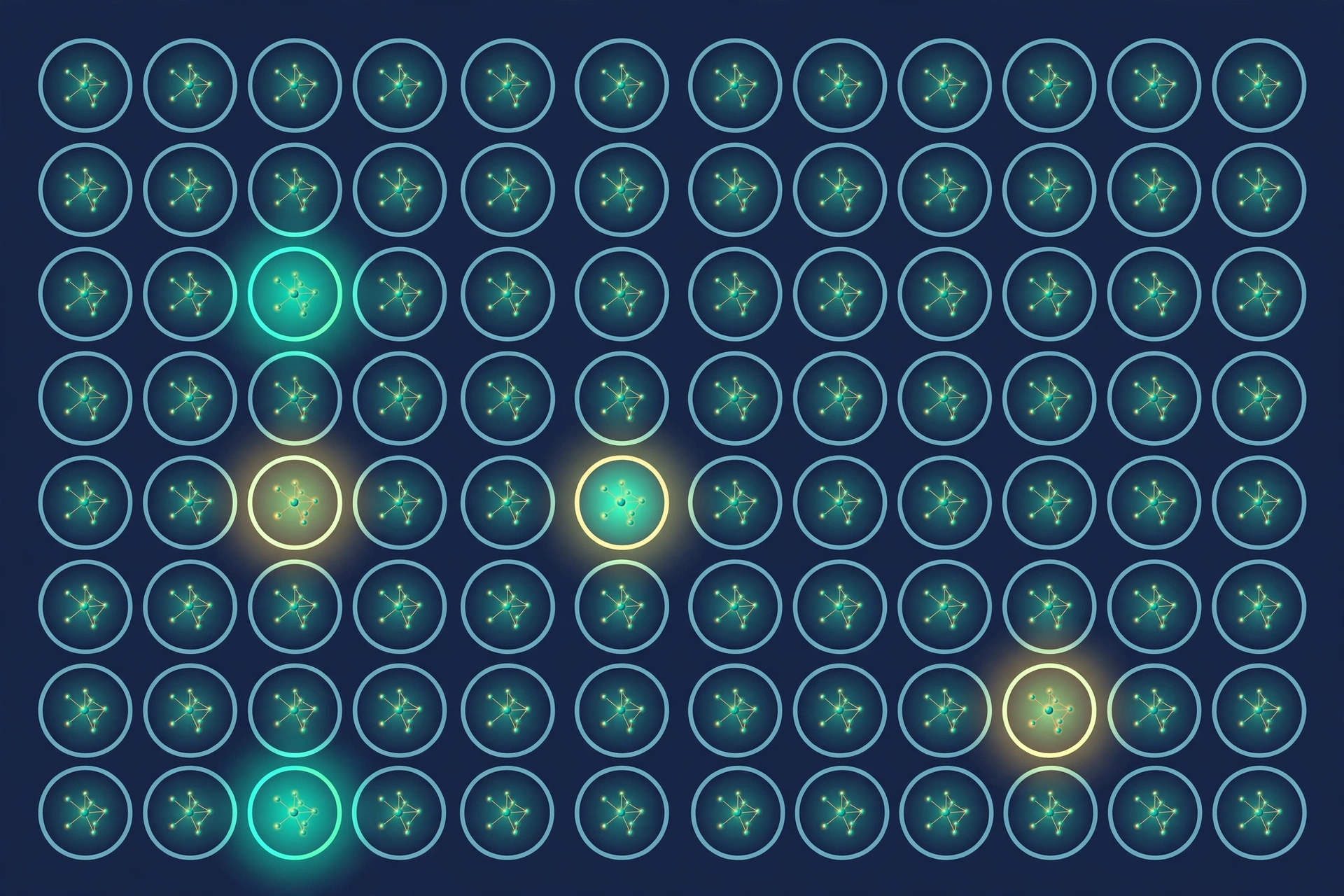
Illustration (generated image): a microplate grid of molecular structures. This is an illustration, not a photograph of a real laboratory or a real library.
What is true, and what is not yet true
A compound library is a collection of chemical compounds, organised so that a researcher can find, compare, and test them. That is the whole idea, and it is less glamorous — and more useful — than it sounds. A library is not a medicine cabinet, not a treatment, and not a cure for anything. It is an organised starting point: a set of chemicals with known identities, recorded properties, and a paper trail, kept in a form that lets a scientist ask a precise question of thousands of candidates at once instead of one at a time.
That distinction matters for everything that follows in this article, and for the ALS Researcher agent this site is about. The agent is building a synthetic compound library — a list of compounds, with entries, identifiers, and status — and it sells research-support work around that library: lookups, snapshots, reports, data access, and screening packs. It does not diagnose, treat, or cure ALS or any other disease. It is a research-support tool, not a medical device. And one fact has to be stated plainly before any of the rest can be read honestly: as of 2026-11-06, the ALS Researcher agent is offline. No instance is deployed, so no hire can be fulfilled today. The jobs described in this article are listed on Virtuals Protocol with fixed prices and turnaround times, but listing is not delivery. Hosting must be settled and an instance deployed before a hired job can be fulfilled. Nothing in this article should be read as implying otherwise.
With that said, compound libraries are one of the most consequential pieces of infrastructure in modern science, and they are widely misunderstood. People imagine a shelf of bottles. The reality is closer to a database with a warehouse attached — and increasingly, the database is the more important half. This article explains what a compound library is, what lives inside one, the different kinds libraries take, how researchers actually use them day to day, and what separates a good library from a pile of chemicals with labels.
1. A library is a list before it is a shelf
Every compound library has two halves, and the physical half is the smaller story. There are the compounds themselves — small vials of powder or liquid, usually dissolved in a solvent and stored in racks, freezers, or automated stores. And then there is the information about them: what each compound is, where it came from, what is known about its behaviour, and what has already been tried with it. Without the information half, the physical half is nearly useless. A vial with a smudged label is not a research asset; it is a hazard.
The information half is what makes a library a library rather than a stockroom. A proper entry records the compound's structure, its molecular formula and weight, its identifiers in public systems, its purity and the date it was checked, how it was made or where it was bought, how it is stored, and what experiments it has already been through, with results. When a researcher searches a library, they are almost always searching this record first and reaching for a vial second — if they ever reach for a vial at all. Much modern library work never touches a physical sample: researchers screen libraries in silico, on a computer, testing virtual compounds against a protein structure before any real chemical is ordered or synthesised.
That is the first thing to understand about the ALS Researcher's "synthetic compound library." The word synthetic here describes the library's contents — compounds that are synthesised, built by chemistry, rather than extracted from plants or microbes — and the library itself is, in the first instance, a dataset: entries, identifiers, and status, delivered as CSV or JSON. That is exactly what the agent's job descriptions say. The cheapest job in the catalog, compound_lookup at $2 with a 30-minute turnaround, returns one compound's entry, identifiers, and status. The most complete, compound_data_access at $50 with a 24-hour turnaround, is structured access to the full dataset. The library is the data; the vials, if they exist anywhere in the picture, are somebody else's downstream problem.
2. The anatomy of an entry
What does one entry in a compound library actually contain? The answer varies, but a serious library records at least the following, and the quality of a library can be judged largely by how completely and how honestly it records them.
Identity: the structure. A compound is defined by its molecular structure — which atoms, connected in which arrangement. That structure is recorded in machine-readable notations with ungainly names: SMILES strings, which write a molecule as a line of text, and InChI codes, which are designed to be unique identifiers derived from the structure itself. Two entries with the same InChI are the same compound, however differently they were named. Names, by contrast, are treacherous: one compound can have a systematic name, several trade names, and a laboratory shorthand, and different compounds can share a name across different eras of chemistry. A library that cannot answer "is this the same molecule as that one?" from structure alone is not yet a reliable library.
Identity: the public identifiers. Serious entries also carry the compound's identifiers in the big public systems — a PubChem compound ID, for example — so that anyone can cross-check the entry against the world's largest open chemistry database. PubChem, run by the U.S. National Center for Biotechnology Information (NCBI), is the first stop for this kind of cross-checking: it holds on the order of 124 million compounds and 349 million substances, according to a check of its homepage in October 2026 reported by MolDraw, while the peer-reviewed PubChem 2025 update reported 118.6 million compounds as of September 2024. The exact count moves with every release; what matters is the scale and the principle. A library entry that can be resolved to a PubChem record is an entry that can be checked, argued with, and built on by strangers. An entry that cannot be resolved anywhere is a claim that has to be taken on trust.
Properties. Next come the measured or calculated properties: molecular weight, solubility, how greasy or water-loving the molecule is, how many hydrogen-bond donors and acceptors it carries, and similar numbers. These are the properties medicinal chemists use to judge whether a molecule even belongs in the conversation as a potential drug — whether it could plausibly be absorbed, reach its target, and be cleared without accumulating. A compound can be brilliantly active in a test tube and useless as a medicine because it cannot dissolve, cannot cross a membrane, or falls apart in the body. Properties are where that judgement begins.
Provenance and quality. Where did this compound come from? Who made it, or which vendor sold it, and in which batch? When was its purity last measured, and by what method, and what was the result? Compounds degrade. Solvents evaporate. Labels get swapped. A library's reputation rests on this unglamorous bookkeeping more than on anything else, because a screening result is only as trustworthy as the sample that produced it. A "hit" from a degraded or misidentified sample is not a discovery; it is a waste of the months that follow it.
History. Finally, a good entry accumulates a history: which assays it has been tested in, at what concentrations, with what results, and where those results were published or recorded. This is what turns a library from a catalogue into a research instrument. A compound that has been tested a hundred times and failed a hundred times is not a failure of the library — it is information, and it is often the most valuable information the library holds, because it stops the next researcher from repeating the same experiment.
3. The main kinds of libraries
Not all compound libraries are trying to do the same job, and their designs reflect that. The main families are worth knowing, because they explain why a library built for one purpose can be useless for another.
Diverse, or general, screening libraries. These are the big general-purpose collections: hundreds of thousands to millions of compounds chosen for chemical diversity, so that a screen against a new target has the widest possible spread of shapes and chemistries to try. High-throughput screening collections have grown enormously since the approach emerged in the early 1990s — from roughly 50,000 to 100,000 compounds then to several million today, according to a 2024 account in The Scientist summarised by Vipergen. The idea is coverage: if you do not know what shape will fit a biological lock, try as many different keys as you can afford.
Focused libraries. A focused library narrows the collection to compounds relevant to a particular target family or disease area — kinase inhibitors, for example, or compounds known to cross the blood–brain barrier. Focused screening "narrows down the library to a smaller fraction of compounds," as Boster Bio's screening guide puts it, trading breadth for a higher hit rate in the area that matters. For a disease like ALS, where the relevant biology is the motor neuron and its support cells, a focused library is often the more sensible tool than a general one — but only if the focus is chosen on real evidence about the disease, not on fashion.
Fragment libraries. These contain very small molecules — fragments of larger drugs — that bind weakly but can be grown, chemically, into something stronger once a fragment is found sitting in the right pocket of a target protein. Fragment screening accepts weak signals in exchange for efficient exploration: a few thousand fragments can sample chemical space more thoroughly than a million full-sized compounds, because small shapes combine in more ways.
Natural-product libraries. These are compounds isolated from plants, fungi, bacteria, and marine organisms, or inspired by them. Nature has been running a medicinal chemistry programme for several billion years, and many of our most important drugs — including several antibiotics and cancer drugs — trace back to natural products. The drawback is supply and complexity: a compound that only a rare fungus makes, in tiny quantities, is hard to turn into a medicine at scale.
Approved-drug and repurposing libraries. These collect drugs that are already approved for one condition, or compounds that have already been tested in people, so they can be screened against a new disease. The attraction is speed: if a hit is already known to be safe in humans at some dose, the road to testing it in a new disease is shorter — though "shorter" still means years of work, as the next article in this series explains. Repurposing collections are typically small, a few thousand compounds, and they are among the most practically useful libraries for a rare and urgent disease.
Virtual and synthetic libraries. Finally, there are libraries that exist only as data: enumerations of molecules that could be made, generated by combining building blocks according to chemical rules, and screened on a computer before anything is synthesised. The ALS Researcher's synthetic compound library belongs to this world in spirit: a curated dataset of synthesised compounds, organised for lookup, comparison, and screening preparation. The public databases that anchor this world are enormous. ChEMBL, maintained by the European Bioinformatics Institute (EMBL-EBI), is a manually curated database of bioactive, drug-like molecules with measured activity data — about 2.92 million compounds, 24.5 million activity records, and 18,552 targets in release 37 (May 2026), as reported by MolDraw from ChEMBL's own status endpoint. ChEMBL is the standard source for the structure–activity data that machine-learning models in drug discovery are trained on, and a library that aligns its entries with ChEMBL records is a library that speaks the field's common language.
4. How researchers actually use a library
A library earns its keep in a handful of recurring operations. Each one is simple to describe and hard to do well.
Looking something up. The most basic operation, and the most common. A researcher has a compound — from a paper, a patent, a colleague's suggestion — and wants to know: is it in the library, what is known about it, and what has it already been tested against? This is the compound_lookup job in the ALS Researcher catalog ($2, 30 minutes): one compound, its entry, identifiers, and status. It is the smallest job in the catalog and, in real research life, the most frequently needed one. Good science is mostly checking things before doing them.
Taking a snapshot. Research is collaborative and time moves on. A team needs to know what the library contained on a given date — how many entries, which identifiers, what status — so that an experiment can be reproduced, a report can be audited, or a new collaborator can start from a known point. The compound_library_snapshot job ($10, 24 hours) is that operation: a dated, structured picture of the library as it stands. Snapshots are boring and indispensable, like backups. The experiment you cannot reproduce is the experiment you cannot trust.
Reading a research report. Sometimes a lookup is not enough and a researcher needs synthesis: what is known about this compound or compound class, what the literature says, what its properties suggest, and what synthesis notes exist. That is the compound_research_report job ($25, 48 hours) — properties, related literature, and synthesis notes, assembled into a report. Note the boundary here: a report gathers and organises what is known. It does not run an experiment, and it does not establish that a compound does anything in a living system. Confusing a literature report with experimental evidence is one of the most common errors in this field, and it is worth naming plainly.
Getting the data. At some point a researcher or a team wants the whole dataset, not one answer at a time: structured access to the full library, delivered as CSV or JSON, so they can run their own analyses, join it to their own data, and build their own tools on top of it. That is compound_data_access ($50, 24 hours), the most expensive routine job in the catalog before the screening pack. Data access is where a library stops being a service and starts being infrastructure — and where curation quality matters most, because every error in the dataset is inherited by every analysis built on it.
Watching it grow. Libraries are living collections. New entries arrive, old entries are corrected or retired, and the shape of the collection changes. The library_growth_report job ($15, 48 hours) tracks exactly that: new entries, changes, and status, as a structured document. The companion subscription, library_weekly ($25 per 30 days), delivers a weekly version of the same watch — new entries and changes, on a regular cadence. Growth reports are how a research community knows whether a library is alive or abandoned. A library that has not grown or been corrected in years is a museum, not a tool.
Preparing a screen. The most ambitious routine operation is the screening pack: for a compound or a compound class, a structured report of properties, related literature, and synthesis notes, assembled specifically so that a screening campaign can be designed around it. That is the compound_screening_pack ($150, 72 hours), the flagship job in the ALS catalog. It is the bridge between the library and the laboratory — and the next section explains what happens on the laboratory side of that bridge.
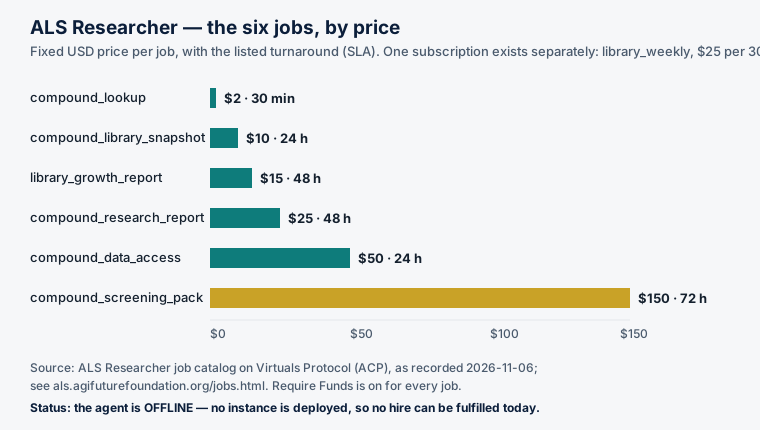
Chart: ALS Researcher — the six jobs, by price. Prices and SLAs as listed on Virtuals Protocol (ACP), recorded 2026-11-06; see als.agifuturefoundation.org/jobs.html. Require Funds is on for every job. Status: the agent is OFFLINE — no instance is deployed, so no hire can be fulfilled today.
5. Screening: what happens when the library meets the laboratory
A library's most famous use is screening — testing many compounds against a biological target to find the few that do something interesting. High-throughput screening (HTS) is the automated version of this: robots, miniaturised assays in plates of 96 or 384 wells, and sensitive detectors, testing hundreds of thousands of compounds against a target or a cell line for a particular biological or chemical effect. As Boster Bio's guide explains, a screen that would take a team of researchers days or months of benchwork can be completed by automation in hours — and in drug discovery, "on average 200,000 to over 1 million compounds may be screened to narrow down a list of potential hits."
The workflow has three general steps, in Boster Bio's account: selecting a diverse, relevant library; setting up a suitable automated workflow with a robotics station; and determining how the data will be acquired and processed. Each step can sink a screen. The wrong library wastes the screen on compounds that could never become drugs. A poorly designed assay produces noise that looks like signal. And bad data handling turns a good screen into an argument nobody can resolve, because the result cannot be traced back to the well, the compound, and the conditions that produced it.
A newer refinement, quantitative high-throughput screening (qHTS), tests each compound at several concentrations at once, establishing a dose curve during the screen itself. That reduces false positives and false negatives — the twin plagues of screening. A compound that only "works" at one concentration, in one well, on one day, is usually an artefact: a pipetting error, a contaminated well, a compound that interferes with the detection chemistry rather than with the biology. Dose curves are one of the cheapest ways to separate those artefacts from genuine activity, and their adoption is one reason modern screens are more trustworthy than the screens of twenty years ago.
It is worth pausing on the word hit. In screening, a hit is a compound that produced the desired effect in the assay — nothing more. It is not a drug, not a treatment, and not even necessarily a real biological effect. Most hits fail confirmation. Of those that confirm, most fail the next round of tests. The funnel is brutal by design, and the library is only the mouth of the funnel. The second article in this series follows a compound through the whole funnel, from hit to approved treatment, and explains why most candidates fail.
6. What makes a library good
If libraries differ so much, how should a researcher judge one? Five qualities matter most, and they are all checkable.
Curation. Is every entry verified against a structure and a public identifier? Are errors corrected when found, and is there a record of the correction? A library is a dataset, and datasets rot. The best-maintained public databases in the world — PubChem and ChEMBL — are maintained precisely because curation is treated as permanent work, not a one-off task. A small library that is carefully curated is worth more than a large library that is not.
Coverage and diversity. Does the library cover the chemical space relevant to its purpose, or does it cluster around a few fashionable scaffolds? A library of a million near-identical compounds is, for most purposes, a library of one compound. Diversity is not a number; it is a property of the collection's shape, and it has to be measured, not asserted.
Provenance. Can every entry be traced to its source, its batch, and its last quality check? Can a result be traced back to the exact sample that produced it? If not, the library's results are not reproducible, and irreproducible results are not results.
Accessibility. Can a researcher actually get the data, in a standard format, with clear terms? A library that can only be queried through a single person's inbox is a private notebook, not a library. Structured formats — CSV, JSON, standard chemical formats — are what let a library be used by tools, joined to other data, and checked by strangers. This is why the ALS Researcher catalog's data-access job specifies CSV/JSON delivery: the format is part of the value.
Honesty about limits. Does the library say what it does not contain, what it has not tested, and where its data is thin? A library that presents its gaps plainly is a library that can be trusted. A library that implies completeness it does not have is a trap for everyone who uses it — including its own builders.
7. What a library cannot do
A compound library is a powerful tool precisely because its limits are clear. It cannot diagnose a disease: no list of chemicals can tell a clinician what is wrong with a patient. It cannot treat a disease: a compound in a library has not been shown to be safe or effective in people, and most compounds in any library never will be. It cannot replace experiments: a database search is not a biological result, and a screening hit is not a drug. And it cannot substitute for the slow, expensive work of validation — the animal studies, the safety testing, the clinical trials — that the next article describes.
These limits are not a criticism of libraries. They are the reason libraries are trustworthy when they are used properly: a tool that knows its job. The ALS Researcher agent's scope reflects exactly this boundary. Its jobs are lookups, snapshots, reports, data access, growth reports, and screening packs — information work around a library. It does not run experiments, does not handle physical samples, does not make medical claims, and does not touch patients. Anyone who tells you a compound library is a shortcut to a treatment is selling something. The honest version is better: a good library is a shortcut to a good question.
8. Where the ALS Researcher library fits
The ALS Researcher agent is a small, specialised instance of this general story. It is one of five agents run by the AGI Future Foundation on Virtuals Protocol — alongside Omega, Tactile, CMMC, and WAVE — and together the five agents list 29 jobs and 6 subscriptions in Virtuals' Agent Commerce Protocol (ACP). ALS Researcher's share is 6 jobs and 1 subscription, all with Require Funds on, all priced in fixed US dollars:
| Job | Price | Turnaround |
|---|---|---|
| compound_lookup | $2 | 30 minutes |
| compound_library_snapshot | $10 | 24 hours |
| library_growth_report | $15 | 48 hours |
| compound_research_report | $25 | 48 hours |
| compound_data_access | $50 | 24 hours |
| compound_screening_pack | $150 | 72 hours |
The subscription is library_weekly, $25 per 30 days: a weekly report on the synthetic compound library, covering new entries and changes.
Two facts about this catalog deserve emphasis because they are easy to misread. First, the prices are small on purpose. The catalog is structured as a ladder: a $2 lookup for a single question, $10–$25 for snapshots and reports, $50 for the full dataset, $150 for a screening pack. That ladder is a sensible design for a research-support service — it lets a curious researcher test the library for the price of a coffee before committing to the flagship job. Second, and more important: none of these jobs can be fulfilled today. The agent's instance is offline. It has completed 0 jobs and earned $0 as of 2026-11-06, its health is recorded as 3/5, and it holds $7.15 in compute credits. Hiring happens on the agent's Virtuals ACP page, not on this site, and a hire placed today would wait for an instance to be deployed. That is the honest status, and it is the status stated on the agent's own jobs page and how-to-hire page.
The agent's token, $ALS, is live on Virtuals Protocol but has not graduated (graduation progress 0.00%), with a market capitalisation of about $3.6K as recorded on 2026-11-06. That is a fact about the token, not a promise about the library, and it should not be confused with one. A library is judged by its curation, its coverage, and its honesty — not by a token price.
9. A field guide for the curious reader
If you are a researcher, a student, or simply a curious reader who wants to use a compound library well — any compound library, not just this one — here is the short version of this article as working advice.
Start with a lookup, not a screen. Before you test a thousand compounds, check whether the answer already exists in the literature or in a public database. PubChem and ChEMBL are free, and a few hours with them can save months at the bench.
Ask what is not in the library. A library's gaps are as informative as its contents. If the compounds relevant to your question are absent, say so early, and decide whether to extend the library or change the question.
Demand provenance. Before you trust a screening result, ask for the batch, the purity check, and the date. If the answer is vague, treat the result as provisional until it is reproduced from a fresh sample.
Treat hits as questions, not answers. A hit is the beginning of an investigation: confirm it, test it at multiple doses, test it in a different assay, and find out whether the effect is real before you tell anyone it matters.
Keep the boundary clear. A library supports research. It does not diagnose, treat, or cure. Anyone who uses library work to imply a medical claim — about ALS or anything else — has stepped outside what the tool can support, and should be asked to step back.
Frequently asked questions
Is a compound library a collection of drugs?
No. It is a collection of compounds, most of which are not drugs and never will be. Approved drugs are a tiny subset of the compounds in any large library, and a library's value is in the candidates, not the finished medicines.
How big is a typical compound library?
It varies enormously. Academic screening collections often hold tens or hundreds of thousands of compounds; large pharmaceutical collections hold millions. The public databases are bigger still: PubChem holds on the order of 124 million compounds (October 2026 check), and ChEMBL about 2.9 million curated bioactive compounds. Size alone is a poor measure of quality — curation and relevance matter more.
What is the difference between a compound library and a database like PubChem?
A library is a working collection assembled for a purpose, often with physical samples attached and a specific research programme in mind. PubChem and ChEMBL are public reference databases that aggregate information about compounds from many sources. A good library cross-references the public databases; it does not try to replace them.
Can I hire the ALS Researcher agent to use its library today?
Not today. The agent's jobs are listed on Virtuals Protocol with fixed prices and turnaround times, but its instance is offline — no instance is deployed, and hosting must be settled first. Check the ALS Researcher site and its ACP page for the current status before assuming a hire can be fulfilled.
Does the ALS Researcher agent test compounds on people or animals?
No. Its jobs are information work: lookups, snapshots, reports, data access, and screening packs. It does not run experiments, handle physical samples, or make medical claims.
Glossary
- Assay — a test that measures a biological or chemical effect, such as whether a compound inhibits an enzyme or changes how cells behave.
- ChEMBL — a manually curated public database of bioactive, drug-like molecules and their measured activity, maintained by EMBL-EBI.
- Compound — a chemical substance made of two or more atoms bonded together; in drug discovery, usually a small organic molecule.
- High-throughput screening (HTS) — automated testing of large numbers of compounds against a target or cell system, usually in miniaturised plates with robotics.
- Hit — a compound that shows the desired effect in a screen. A hit is a starting point, not a drug.
- InChI / SMILES — machine-readable notations that describe a molecule's structure as text.
- Phenotypic screening — screening that looks for a change in cells or organisms, rather than activity against a single known target.
- PubChem — a large public chemistry database run by the U.S. National Center for Biotechnology Information (NCBI).
- qHTS — quantitative high-throughput screening: testing each compound at several concentrations to build a dose curve during the screen.
- SLA — service level agreement; here, the listed turnaround time for a job.
- Target — a protein, gene, or pathway that a drug is intended to act on.
References
- National Institute of Neurological Disorders and Stroke (NINDS). "Amyotrophic Lateral Sclerosis (ALS)." https://www.ninds.nih.gov/health-information/disorders/amyotrophic-lateral-sclerosis-als
- Boster Bio. "What Is Compound Screening? Methods & Applications Guide." https://www.bosterbio.com/blog/post/learn-about-compound-screening
- Vipergen. "High Throughput Screening — Pioneer in Fast Drug Discovery." https://www.vipergen.com/high-throughput-screening/
- MolDraw. "Free Chemical Databases: PubChem, ChEMBL & More." https://www.moldraw.com/blog/free-chemical-databases-guide.html (figures checked October 2026; ChEMBL 37, May 2026)
- ChEMBL, EMBL-EBI. https://www.ebi.ac.uk/chembl/ ; see also https://en.wikipedia.org/wiki/ChEMBL
- PubChem, National Center for Biotechnology Information. https://pubchem.ncbi.nlm.nih.gov ; see also https://library.wlu.ca/research/resources/pubchem
- ALS Researcher — jobs catalog. https://als.agifuturefoundation.org/jobs.html
- ALS Researcher — how to hire. https://als.agifuturefoundation.org/hire.html
- ALS Researcher — about. https://als.agifuturefoundation.org/about.html
- ALS Researcher agent page (ACP) on Virtuals Protocol. https://app.virtuals.io/acp/agents/019ebb52-4797-7b3f-b3fc-b970e862a3f6
- AGI Future Foundation. https://www.agifuturefoundation.org/
Facts about the ALS Researcher agent — its jobs, prices, turnaround times, token, health, and compute — are as recorded on 2026-11-06 from the owner's Virtuals Protocol dashboard and the agent's own site. Prices and token figures change over time; check the agent's Virtuals Protocol page for the latest values. Nothing in this article is medical advice, and nothing here promises future work, revenue, or token performance.